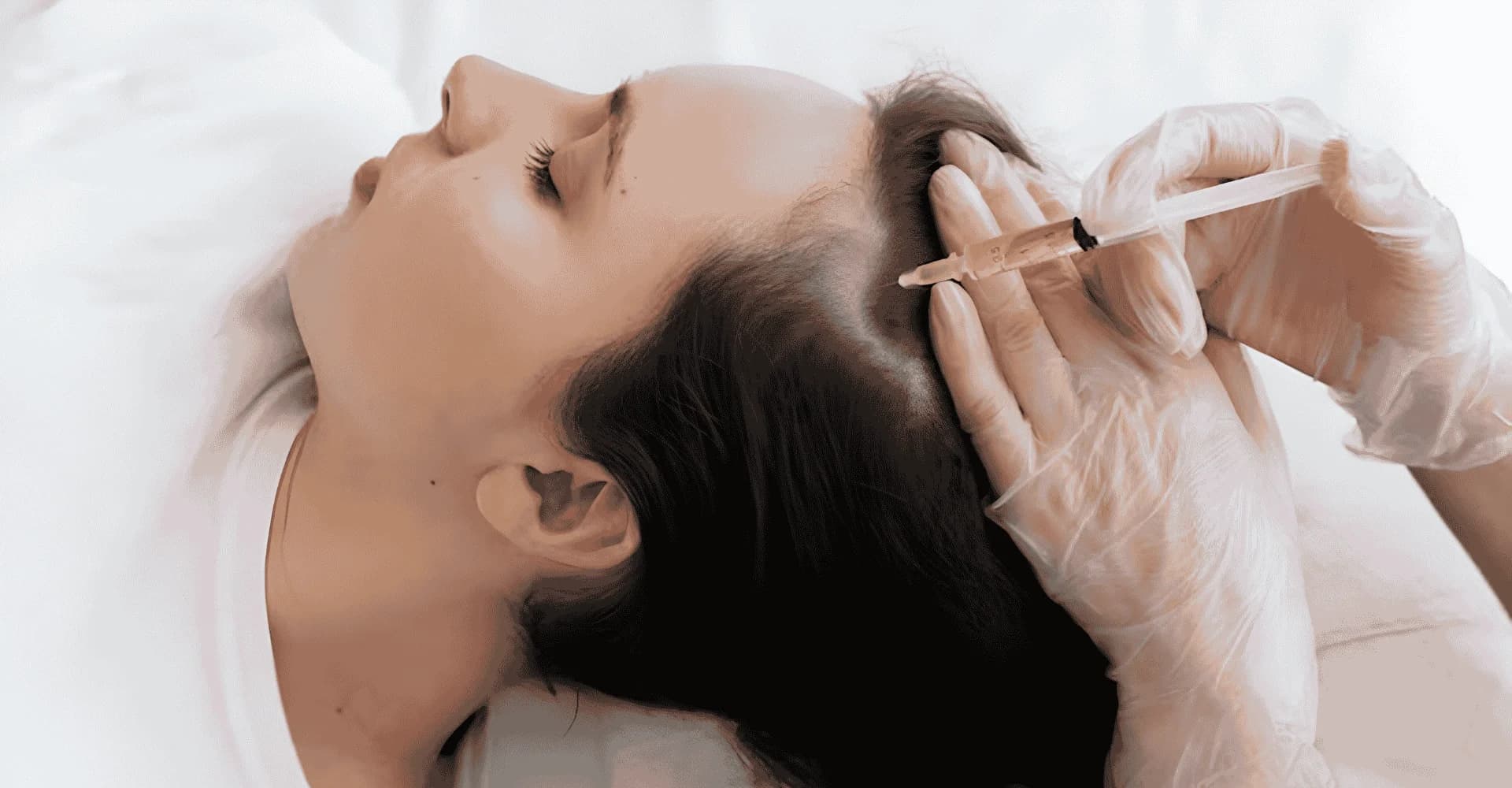
Exosomes are tiny extracellular vesicles — 30 to 150 nanometers in diameter — that carry growth factors, genetic material, and proteins between cells. PRP isolates growth factors from your own blood. Both trigger cellular repair, but through different mechanisms and with different evidence bases. Beauty Aesthetics in Vaughan, Ontario offers both exosome based treatments and PRP. This guide explains what each one actually is, who suits each, and why the distinction matters before you book a treatment plan.
Key Takeaways
- Exosomes are 30 to 150 nanometers in diameter and carry a significantly concentrated cargo of growth factors and genetic material — comparative potency versus PRP is not yet standardised in published evidence.
- PRP uses the patient’s own blood; Beauty Aesthetics’ exosome products are plant and fungi-based — no blood draw required.
- Exosome therapy is still largely investigational — no exosome products are currently approved by Health Canada or the FDA for systemic use, and Health Canada has seized unauthorised exosome injectables from Ontario providers.
- Some patients report visible improvements in hair growth and scalp health within one month of exosome treatment, though individual response varies; PRP hair growth results typically appear over 3 to 6 months.
- Combining exosome therapy with PRP may enhance hair growth results, supporting new hair growth beyond what either treatment achieves alone.
Exosome Therapy Is, Defined
Exosomes are membrane-bound vesicles that act as intercellular communication messengers. The products used at Beauty Aesthetics — EXO|E and DE|RIVE — are 100% plant and fungi-based, derived from 23 species, with no animal or human-derived components. They carry proteins, growth factors, lipids, essential proteins, amino acids, and genetic material including mRNA and microRNA. Their lipid shell allows exosomes to survive in harsher physiological environments than free-floating proteins could, and their small size — 30 to 150 nanometers — allows them to cross biological barriers and reach target cells that larger molecules cannot. When delivered into the scalp or skin, exosomes transfer their active molecular cargo to recipient cells, triggering regenerative processes that the recipient cells then carry out using their own biological machinery — a fundamentally different mechanism from PRP, which delivers growth factors directly rather than communicating instructions at the gene expression level.
How Exosome Therapy Works
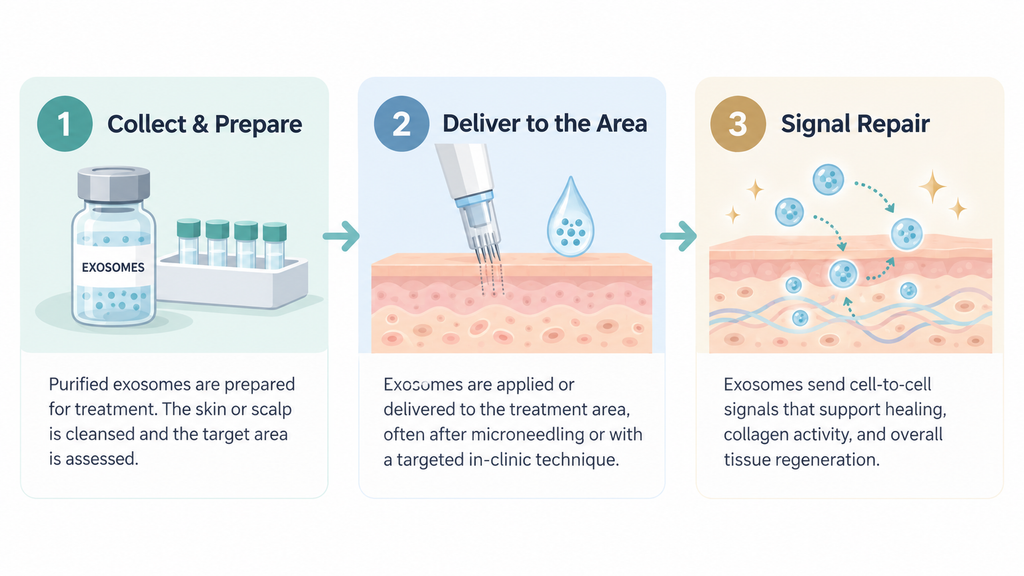
Exosomes do not act on tissue themselves. They deliver instructions — via bioactive molecules and genetic material — that change how recipient cells behave.
Step by Step
Stage One
Exosomes are prepared from a donor stem cell source, concentrated, and quality-tested. Unlike PRP, this process requires no blood draw from the patient. The concentrated growth factors and bioactive molecules are loaded into a sterile solution ready for application.
Stage Two
The solution is delivered into the target tissue — the scalp for hair regrowth, or the skin’s surface for skin rejuvenation — either by microinjection or applied topically following microneedling. Each session typically takes 30 to 60 minutes with minimal downtime. Exosomes target specific recipient cells due to surface proteins on their membranes, enabling more precise cell to cell communication than a general growth factor injection can achieve. They also stimulate angiogenesis — the formation of new blood vessels — which improves blood circulation to hair follicles and speeds healing.
Stage Three
At the cellular level, recipient cells — including dormant hair follicle cells — receive the exosome cargo and begin responding: stimulating collagen production, reducing inflammation, improving blood circulation to hair follicles, and activating the body’s natural processes for tissue repair. Exosomes can reactivate dormant hair follicles, which is the mechanism driving their use in hair restoration. Unlike PRP, which primarily delivers growth factors directly, exosomes work at the gene expression level — influencing how hair follicle cells behave rather than simply feeding them nutrients. Most patients notice visible improvements within one month of treatment, with fuller hair and improved scalp health developing over the following weeks.
The Main Types of Exosome Treatment
Exosome therapies differ primarily by source, concentration, and delivery method. Clinical protocols are not yet standardised — this is one of the key regulatory concerns.
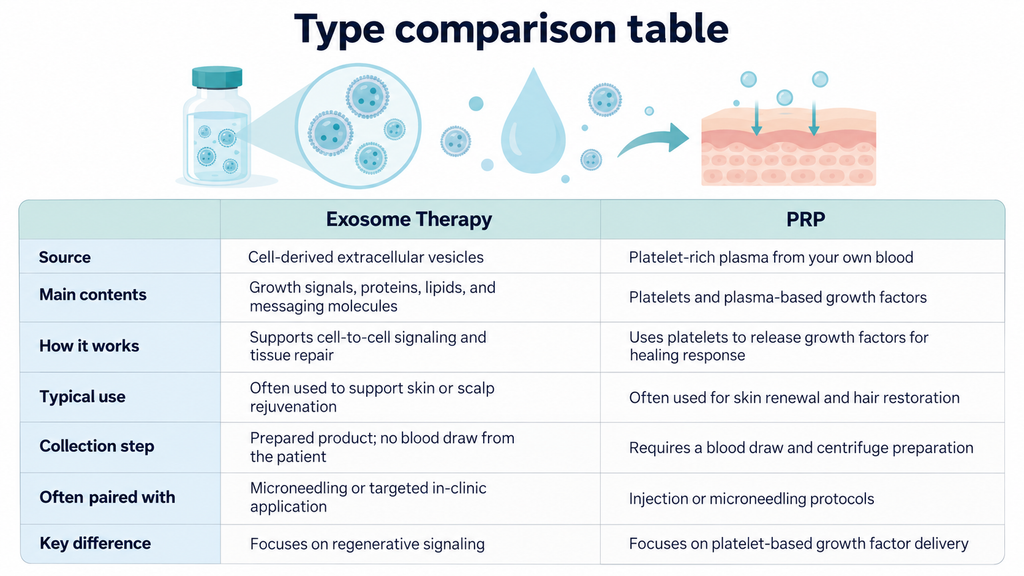
Type Comparison Table
| Attribute | Exosome therapy | PRP (Platelet-Rich Plasma) |
|---|---|---|
| Source | Mesenchymal stem cells (donor) | Patient’s own blood |
| Blood draw required | No | Yes |
| Growth factor concentration | Very high — concentrated growth factors | Lower — depends on patient’s platelet count |
| Regulatory status | Investigational | Autologous — outside drug regulation |
| Best for | Hair loss, skin rejuvenation, post-procedure healing | Hair loss, skin rejuvenation, musculoskeletal repair |
| Sessions typically needed | 1 to 3 | 3 to 4 initially |
| Results timeline | Within 1 month | 3 to 6 months |
| Immune rejection risk | Low — lower than whole-cell transplants | Near-zero — autologous |
Type One: Injectable Exosome Therapy
DE|RIVE hair exosome therapy delivers concentrated growth factors directly into the scalp to support the hair growth cycle and reactivate dormant follicles. This is the primary protocol used for androgenetic alopecia and hair thinning in clinical settings. The essential proteins and essential nutrients carried in the exosome cargo support the hair follicle’s healing process without introducing any foreign cells into the body. Exosome therapy can enhance the results of existing hair loss treatments when layered into an established treatment plan — particularly for patients dealing with hormonal imbalances or other conditions driving ongoing hair loss.
Best Suited To
Men and women with early to moderate androgenetic alopecia, thinning hair, or general hair growth concerns who want to stimulate hair follicles and promote healthy hair growth without a blood draw. Also appropriate as a post-procedure recovery accelerator after hair restoration procedures.
Limitation to Know
Exosome therapy is still largely investigational; product variability between manufacturers is a real concern. The plant-based formulations used at Beauty Aesthetics carry a different risk profile than human-derived alternatives, but confirming the product source with any provider remains important.
Type Two: Topically Applied Exosome Treatment
Exosomes applied topically — either as a serum or applied immediately after microneedling — improve skin texture, boost collagen production, and address skin concerns including post-inflammatory hyperpigmentation. [Exosome therapy improves skin elasticity and reduces inflammation. A 2025 comprehensive literature review in the Journal of Drugs in Dermatology (PMC11704993) found early evidence supports exosomes for facial rejuvenation, while noting that lack of standardisation limits current clinical application](https://www.ncbi.nlm.nih.gov/pmc/articles/PMC11704993/).
What Exosome Therapy Is Not
Exosome therapy is frequently confused with three things. It is not PRP — PRP draws the patient’s blood, centrifuges it to concentrate platelets, and re-injects it. Exosomes are externally sourced, carry instructions via genetic material, and act at the gene expression level rather than delivering growth factors directly. It is not stem cell therapy — exosomes are vesicles released by stem cells, not the stem cells themselves. No living cells are injected. It is not a drug — currently, no exosome products are approved by Health Canada or the FDA for systemic therapeutic use, which places it in a regulatory grey zone that providers and patients both need to understand before treatment.
For patients wanting to understand how PRP compares in more detail from a skin rejuvenation angle, our post on how PRP therapy works for skin rejuvenation covers the mechanism, evidence, and candidacy in full.
Who It Suits in Ontario
Exosome therapy suits adults in Ontario — men and women dealing with hair thinning, androgenic alopecia, or skin rejuvenation goals — who are comfortable with a treatment that has strong early evidence across published research but is not yet fully standardised in clinical practice. Good candidates have realistic expectations about gradual improvement, not dramatic overnight change. Patients who have already completed a course of PRP for hair loss and plateaued may find exosomes a logical next step — our post on PRP therapy for hair loss benefits explains what PRP typically achieves before combining it with exosomes.
Exosome therapy is not suitable for pregnant or breastfeeding patients, anyone with active scalp infections, or anyone who has not confirmed the regulatory status of the specific exosome product being used with their provider. Patients should always ask about product sourcing, batch testing, and whether the clinic operates under physician oversight before proceeding — exosome therapy is viewed with caution in the medical community due to product variability, and these questions distinguish a safe provider from a risky one.
At Beauty Aesthetics, our exosome therapy in Vaughan service — focused on hair growth and scalp health — uses quality-tested, properly sourced exosome formulations, delivered by Mubeyra Sarkar, RN, under physician oversight. We do not offer exosome treatment without a prior consultation that reviews your hair health history and sets realistic outcome expectations.
Frequently Asked Questions
How does exosome therapy work for hair loss?
Exosome therapy works by delivering concentrated bioactive molecules and genetic material directly to hair follicle cells, triggering dormant hair follicles to reactivate and promoting new hair growth. Unlike PRP, which delivers growth factors from the patient’s blood, exosomes communicate instructions at the cellular level, influencing gene expression in recipient follicle cells.
Is exosome therapy better than PRP for hair regrowth?
Not definitively — the evidence base is still developing. Exosome therapy may deliver significantly more concentrated growth factors than PRP — some studies suggest a substantial difference, though standardised comparative data is limited, and some patients see faster visible improvements. However, PRP has more long-term safety data. Many providers, including Beauty Aesthetics, combine both for enhanced hair restoration outcomes. See what to expect from PRP therapy for hair loss for a full timeline comparison.
What are the side effects of exosome treatment?
Common side effects of exosome therapy include slight redness or post-treatment tenderness at the injection site, typically resolving within 24 hours. Patients usually experience minimal downtime and can return to normal activity the same day. Health Canada has raised concerns about unregulated human-derived exosome injectables specifically. The plant-based exosome formulations used at Beauty Aesthetics are a distinct category. Choosing a provider who can confirm product composition and sourcing matters regardless.
Can exosome therapy be combined with other hair loss treatments?
Early clinical reports suggest combining exosome therapy with PRP may enhance hair growth results, though standardised comparative data is limited. Exosomes can also be layered alongside existing hair loss treatments including minoxidil or laser therapy. For patients assessing whether PRP has been effective before adding exosomes, our guide on whether PRP therapy is effective for skin rejuvenation covers the efficacy evidence base in detail.
About Beauty Aesthetics
Beauty Aesthetics is a medical spa in Vaughan, Ontario, serving patients across the Toronto area since 2020. All exosome therapy in Vaughan treatments are administered by Mubeyra Sarkar, RN, under physician oversight, in compliance with the College of Nurses of Ontario. We discuss regulatory status, product sourcing, and realistic outcomes transparently at every consultation. Contact: +1 647-260-9607.
Service Area
Beauty Aesthetics serves Vaughan, Woodbridge, Concord, Maple, Richmond Hill, North York, and Thornhill. Parking on-site. Evening and Saturday appointments available.
Next Step
Book a free consultation to find out whether exosome therapy in Vaughan fits your hair or skin concern — call +1 647-260-9607 or book online at beautyaesthetics.ca.