Key Takeaways
- Initial results appear within 2 to 5 days; full effects show by 1 to 2 weeks.
- Botox effects typically last 3 to 4 months before fading completely.
- Frown lines usually need 15 to 25 units; forehead lines need 10 to 20 units.
- Botox costs between $10 and $17 per unit in the Toronto area, including Vaughan.
- Botox treats dynamic wrinkles from movement, not static lines from lost volume.
- A qualified medical professional significantly reduces the risk of side effects.
Introduction
Botox before and after results typically show visible softening within a week, peaking around day 14, then gradually fading by month four. This matters because unrealistic expectations, in either direction, lead to disappointment — either from judging results too early, or expecting permanence from a temporary treatment. This guide walks through the full timeline, what results actually look like at each stage, how many units common areas need, and what Botox can’t do.
What Botox Before and After Actually Shows
Botox treats dynamic wrinkles created by movement, like frown lines, forehead lines, and crow’s feet. Before treatment, these lines appear with facial expressions. After treatment, the same expressions no longer create visible creases, since facial muscle contraction is temporarily reduced.
The American Society of Plastic Surgeons notes results typically last three to four months, after which muscle movement gradually returns as the effects of Botox fade. Before and after photos taken at the wrong time can be misleading, since results look different at day 3 versus day 14 versus month 3.
This is one of the most important things to understand before booking a first appointment. A photo taken too early can make an effective treatment look like it “didn’t work,” when the toxin simply hadn’t finished taking effect yet. Conversely, a photo taken at month four might unfairly suggest a treatment faded too quickly, when it actually performed exactly as expected for its typical duration.
How Botox Works
Botox is derived from botulinum toxin type A. Once injected into a targeted facial muscle, it temporarily blocks nerve signals responsible for muscle contraction. This relaxes the muscle, softening the wrinkle that forms above it.
Precise placement and injection technique matter enormously here. An experienced injector uses facial analysis to identify exactly which muscles are creating a specific wrinkle, then targets those muscles directly, leaving surrounding muscles and facial expressions unaffected.
This is also why the same total unit count can produce very different results depending on where, and how precisely, it’s placed. Two patients receiving 20 units for frown lines might see noticeably different outcomes if one injector distributes the product with more precision across the relevant muscle groups. Facial anatomy varies from person to person, which is exactly why a proper facial analysis, rather than a standardized unit count, should guide every treatment plan.
The Botox Timeline: Before, During, and After
Day of Treatment
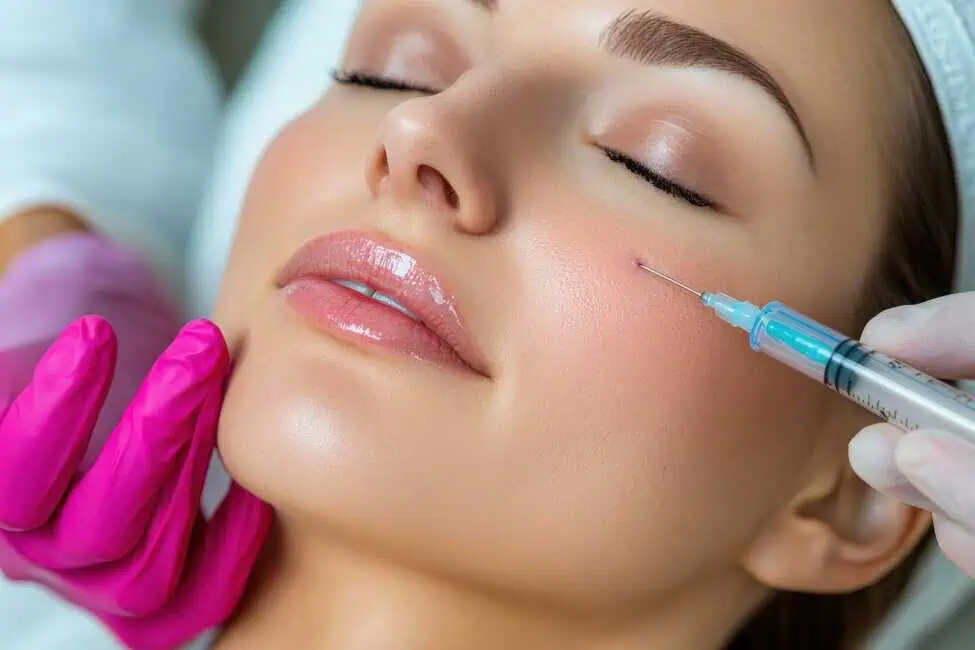
Botox injections typically take about 10 to 15 minutes. Most patients feel only mild discomfort at each injection site. There’s no visible change immediately after treatment, which surprises some first-time patients expecting instant results.
Patients should avoid strenuous activities for 24 hours post-treatment, along with avoiding lying flat or rubbing the treated area, since this can theoretically cause the product to migrate before it has fully settled into the targeted muscle.
Days 2 to 5: Initial Results Begin
Most patients see results within 2 to 5 days after treatment. This is when the botulinum toxin begins blocking nerve signals at the injection site, and the treated muscle starts to relax.
At this stage, results are often subtle and uneven. One side of the face may show more relaxation than the other simply because muscles absorb and respond to the toxin at slightly different rates. This is completely normal and typically evens out as the treatment continues taking full effect over the following week.
Week 1 to 2: Full Results Appear
Full effects of Botox are visible in 1 to 2 weeks. This is the point where before and after comparisons are most accurate, since the treatment has fully taken effect. Providers typically recommend waiting the full two weeks before judging results or requesting adjustments.
If any asymmetry or under-treatment is noticeable at this stage, most clinics offer a follow-up touch-up appointment to fine-tune the result, typically within a two-week window of the original session. This is a normal part of the process for many patients, particularly during a first treatment, and shouldn’t be seen as a failure of the original session.
Month 3 to 4: Results Begin Fading
Botox effects typically last 3 to 4 months before fading. Muscle strength recovery begins around 3 to 4 months post-treatment, and facial muscle strength gradually returns to its pre-treatment baseline.
Patients often notice this fading gradually rather than all at once — a slight increase in movement first, followed by the slow return of visible lines with expression over the following weeks. Scheduling a follow-up treatment before this fading becomes fully noticeable is how many regular patients maintain consistently smooth results year-round.
Month 5: Return to Baseline
Wrinkles may return completely by the fifth month without repeat treatment. This is expected, not a sign anything went wrong. Over time, consistent Botox use may help prevent dynamic wrinkles from deepening further, since repeated muscle relaxation limits ongoing mechanical stress on the skin.
This is one of the more interesting long-term patterns some patients report: after years of repeated treatment, the underlying wrinkles at rest sometimes appear softer even during the months between appointments, compared to how they looked before starting Botox in the first place.
Common Areas Treated and Typical Units
Common areas treated with Botox include forehead lines, frown lines, and crow’s feet. Each treatment area typical units differ based on facial muscle strength and the depth of the wrinkle.
Frown lines typically require 15 to 25 units of Botox. Forehead lines usually need 10 to 20 units. Crow’s feet generally require 10 to 20 units per side, treated symmetrically. Men often require more Botox units than women due to larger, stronger facial muscles, which is an important factor your injector considers during facial analysis.
Beyond these three classic areas, Botox is also commonly used for jaw slimming related to teeth grinding, a lip flip to subtly enhance the upper lip’s appearance, and softening lines around the nose and mouth. Each of these areas requires a different unit range and injection technique, which is why a one-size-fits-all approach rarely produces the most natural looking results. A thorough facial analysis during your initial consultation should account for your specific facial structure, muscle strength, and the areas that matter most to you.
Treatment area typical units also shift over time with repeated sessions. Some patients find that after several treatment cycles, their muscles respond more predictably to a slightly lower dose than they initially needed, since the muscle itself has weakened somewhat from consistent use. This is one reason an ongoing relationship with the same injector, who tracks your specific response pattern across visits, tends to produce more consistently well-calibrated results than starting fresh with a new provider each time.
Botox Cost in the Toronto Area, Including Vaughan
Botox typically costs between $10 and $17 per unit in the Toronto area, including Vaughan, with total treatment cost depending on how many units your specific areas require. A single area like frown lines might cost $150 to $425, while treating multiple areas together increases the total accordingly.
Exact price depends on the clinic, the injector’s experience, and how many units your facial anatomy needs. Comparing prices per unit alone can be misleading, since a more experienced injector charging slightly more per unit may still use fewer total units to achieve the same result. Ask for a full quote based on your specific treatment area during your initial consultation, not just a per-unit rate.
Repeated treatments also factor into your long-term budget. Since Botox effects typically last three to four months, most regular patients schedule three to four sessions per year to maintain consistent results. Factoring this into your annual budget, rather than thinking about cost purely on a per-visit basis, gives a more realistic picture of what ongoing Botox use actually involves financially.
Botox vs Dysport vs Other Neuromodulators
Botox, Dysport, and Nuceiva are all neuromodulators, meaning they work through a similar mechanism of relaxing targeted facial muscles. They aren’t interchangeable on a one-to-one basis, though.
Published dermatology research suggests one unit of Botox is roughly equivalent to two and a half to three units of Dysport, since the two products are formulated and diluted differently. Dysport may spread slightly more from the injection site than Botox, which some injectors use to their advantage in larger, flatter treatment areas like the forehead. Nuceiva is a newer neuromodulator option that’s also FDA approved and Health Canada approved for cosmetic use, giving patients another choice alongside Botox and Dysport.
Choosing between these products often comes down to personal preference and how your body responds to each formulation, rather than one being definitively superior. Some patients find their results kick in slightly faster with one product over another, or that one lasts a few weeks longer for them specifically. A provider experienced with all three can help you decide which is the better starting point, and can also switch products for you in future sessions if your first choice doesn’t produce the response you were hoping for.
Combining Botox With Other Treatments
Many patients combine Botox with other cosmetic treatments as part of a broader treatment plan. Since Botox treats dynamic wrinkles caused by muscle movement, it doesn’t restore lost volume the way dermal fillers do.
Combining Botox with hyaluronic acid fillers addresses both concerns at once: relaxing muscle-driven wrinkles while restoring volume lost to the natural aging process. This combination is common in a full facial rejuvenation treatment plan, particularly for patients addressing multiple signs of aging simultaneously.
Some patients also combine Botox with treatments aimed at improving skin texture, like microneedling or chemical peels, which work on the skin’s surface rather than the underlying muscle. Since these treatments address different layers and mechanisms entirely, they can generally be scheduled within a reasonable window of each other, though your provider will advise on the specific spacing that works best for your combination of treatments.
What Botox Before and After Photos Don’t Show
Before and after photos can be informative, but they also have real limits. Botox does not replace lost facial volume or remove significant sagging skin, since it works only on muscle-driven wrinkles, not structural volume loss.
Photos also don’t capture lighting, camera angle, or how much time has passed since treatment, all of which affect how dramatic a result appears. A conservative, natural-looking result photographed under harsh lighting can look more dramatic than it actually is, and the reverse is also true.
Marketing photos, wherever you encounter them, are also often selected specifically because they show a particularly striking transformation. This doesn’t mean the underlying treatment was dishonest, but it does mean a single dramatic before-and-after pair shouldn’t be treated as a guaranteed, typical outcome for every patient. Your own results will depend on your specific facial anatomy, muscle strength, and how many units are used.
Side Effects and Safety
Common side effects include redness, swelling, and bruising at the injection site, all of which are typically mild and temporary. Muscle weakness in areas near the injection site is a less common but recognized side effect, usually resolving as the treatment wears off.
Botox treatments require qualified medical professionals to avoid serious side effects. Health Canada regulates botulinum toxin type A as a prescription drug, meaning it must be administered by a licensed, trained provider. An allergic reaction is rare but possible, and patients with a known allergy to cow’s milk protein should mention this during consultation, since it’s used in the manufacturing process of some formulations.
A qualified injector will also ask about your sun exposure habits and any recent facial treatments before your appointment, since these can occasionally affect how your skin responds during recovery. Following your provider’s specific aftercare instructions, including avoiding strenuous exercise for the first 24 hours, gives your results the best possible chance of settling evenly.
Who Should Avoid Botox
Patients with neuromuscular disorders should avoid Botox, since the treatment works directly on nerve-to-muscle signaling and can interact with certain underlying conditions. Pregnant or breastfeeding patients are generally advised to wait. Anyone currently taking certain medications that affect muscle function should disclose this during their initial consultation, since it may affect how Botox behaves.
Beyond cosmetic use, Botox is also used for medical conditions like treating excessive sweating, chronic migraines, jaw slimming related to teeth grinding, and overactive bladder, though these applications follow different dosing protocols than cosmetic treatment. Patients considering Botox for any of these medical conditions should be evaluated separately from a purely cosmetic consultation, since dosing, injection sites, and expected timelines differ meaningfully between medical and cosmetic use.
A full medical history review during your initial consultation is the best way to confirm whether Botox is appropriate for you specifically, rather than relying on generic guidance alone. This is also the point where a provider should ask about any previous reactions to botulinum toxin treatments, including from other clinics or products, since this history is directly relevant to your safety going forward.
Be thorough during this step even if a condition seems unrelated to facial treatment. Some medical conditions and their treatments can affect how your body processes botulinum toxin, or how long its effects last, in ways that aren’t obvious without a proper clinical review. A rushed intake process that skips detailed medical history is one of the clearer signs a clinic may not be prioritizing patient safety the way it should.
What Most People Get Wrong About Botox Before and After
Many people compare their day-3 photo to someone else’s two-week result and assume the treatment isn’t working. Full effects of Botox take up to two weeks to appear, so early comparisons are rarely accurate.
The other common mistake is expecting Botox to accelerate skin aging in reverse, restoring elasticity or lost volume it was never designed to address. Botox softens dynamic wrinkles from muscle movement; it doesn’t restore collagen production or lost facial structure the way fillers or other treatments do.
A third common misunderstanding involves assuming more units always produce a better result. Over-treating an area can instead create an unnatural, frozen appearance, limiting facial expressions more than most patients actually want. The goal of a well-planned treatment is softened movement, not eliminated movement, and a skilled injector calibrates units accordingly rather than defaulting to the maximum dose for every patient.
Some patients also assume that because Botox is a widely used, familiar treatment, any provider can perform it safely. Facial anatomy is complex, with dozens of small muscles working together to create expression. Choosing a provider with specific training and experience in facial injections, rather than general medical training alone, makes a meaningful difference in both safety and how natural your final results appear.
Setting Realistic Expectations for Natural Results
Natural beauty and natural looking results come from conservative, well-placed treatment, not from eliminating all movement in the face. Many patients prefer to retain some natural facial expressions, choosing slightly fewer units in exchange for more movement and a softer overall effect. Others, particularly those managing deeper frown lines, may prefer a more thorough approach that prioritizes smoothness over retained movement.
A skilled injector discusses this preference during your initial consultation, tailoring the treatment plan to your facial anatomy and how expressive you want your face to remain, rather than defaulting to maximum muscle relaxation for every patient.
This conversation matters, even if it feels like a small detail. Some patients want a completely smooth forehead with no visible movement at all; others want just enough softening to reduce the appearance of lines while still being able to raise their eyebrows naturally during conversation. Neither preference is wrong, but they call for meaningfully different unit counts and injection patterns, which is exactly why this conversation belongs at the start of your treatment plan rather than as an afterthought.
How to Evaluate Before-and-After Photos Properly
If you’re researching Botox by looking at other patients’ before-and-after photos, check a few details before drawing conclusions. Confirm both photos were taken at the same time of day, under similar lighting, and with the patient making the same facial expression, since expression alone can dramatically change how a wrinkle appears.
Ask, or check, how many days after treatment the “after” photo was taken. A photo captured at day 14, during peak effect, represents a very different stage than one taken at day 60, closer to the point where results begin fading. Reputable clinics are usually transparent about timing when sharing before-and-after results, since it reflects confidence in a consistent, replicable outcome rather than a cherry-picked peak moment.
It’s also worth looking at multiple photos from the same provider across different patients, rather than judging a clinic’s skill from a single striking example. Consistency across a range of facial types and treatment goals is a stronger indicator of skill than one dramatic transformation, which might reflect an unusually favorable starting point rather than technique alone.
The Value of Tracking Your Own Results Over Time
Beyond comparing yourself to other patients’ photos, tracking your own results across multiple treatment cycles offers some of the most useful information available. Many clinics take a baseline photo at your first consultation, then photograph you again at each subsequent visit under consistent lighting and expression.
Over several treatment cycles, this record helps both you and your injector see patterns — whether your results are lasting the expected three to four months, whether unit adjustments in certain areas are improving outcomes, and whether your facial muscles are responding consistently over time. This kind of ongoing tracking turns Botox from a series of isolated appointments into an informed, evolving treatment plan tailored specifically to how your face responds.
Frequently Asked Questions
What do Botox before and after results actually look like?
Botox before and after results show smoother, less mobile skin in the treated area, with dynamic wrinkles softened rather than static lines erased completely. Initial changes appear within 2 to 5 days, with full results visible by week two, then gradually fading back to baseline by month four or five without repeat treatment. Photos taken too early rarely reflect the true final outcome.
How much does Botox cost in Toronto and Vaughan?
Botox cost in the Toronto area, including Vaughan, typically ranges from $10 to $17 per unit, with total treatment cost depending on how many units your specific areas need. Frown lines generally require 15 to 25 units, while forehead lines need 10 to 20 units, making total cost highly individual. Always request a written quote based on your specific facial anatomy during consultation.
Can I combine Botox with other cosmetic treatments?
Yes, many patients combine Botox with dermal fillers or other treatments as part of a broader treatment plan. Botox addresses muscle-driven dynamic wrinkles, while fillers restore lost volume, so combining both often produces more complete, natural looking results than either treatment alone. Your provider can advise on appropriate timing and spacing between different treatments.
How long do Botox results last before fading?
Botox results typically last 3 to 4 months. Muscle strength recovery begins around month three or four, and wrinkles may return completely by month five without a repeat treatment. This is expected and not a sign the initial treatment failed. Many regular patients schedule three to four sessions per year to maintain consistent results year-round.
Is Botox use safe for first-time patients?
Yes, when performed by a trained, licensed medical professional. Botox use carries minor, temporary side effects like redness or mild bruising for most patients. Serious complications are rare when qualified providers use controlled doses and proper injection technique, which is why choosing an experienced injector, and disclosing your full medical history, matters for a safe first appointment.
Why Choose an Experienced Injector
Precise injection technique and accurate facial analysis are what separate natural-looking Botox results from an overdone or uneven appearance. Beauty Aesthetics uses Health Canada-approved botulinum toxin, administered by experienced physicians and registered nurses trained specifically in facial anatomy, with every treatment plan built around your individual muscle strength and goals.
This checklist of what to expect — timeline, units, cost, and realistic results — reflects the same standard applied at every consultation. Patients are walked through their specific facial anatomy before any product is discussed, so recommendations are based on what your face actually needs rather than a generic package. Transparent, written treatment plans and clear pricing are standard practice, not an upsell reserved for patients who ask the right questions.
Ready to See Your Own Before and After?
Understanding the real Botox timeline helps set expectations before you ever sit in the chair. Knowing what results look like at day 3 versus day 14 versus month 4 means you can judge your own results fairly, rather than comparing yourself to a mismatched photo online.
Beauty Aesthetics offers a free consultation to assess your facial anatomy, discuss realistic units and pricing, and build a treatment plan suited to your goals. Call +1 647-260-9607 or book online to get started.